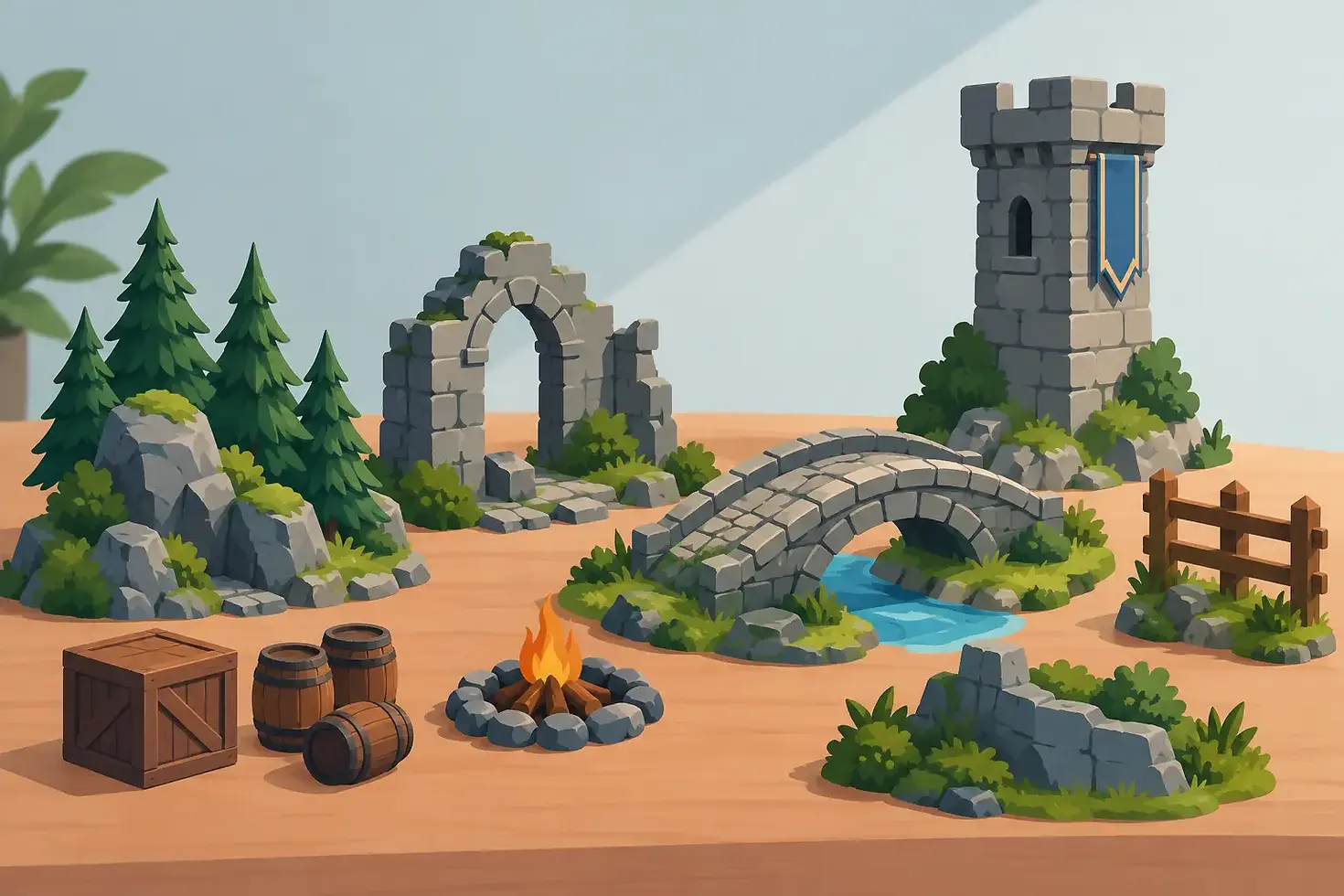
Tabletop Terrain Accessories That Set the Scene

A dragon encounter feels rather less terrifying when the party is standing around an empty battle mat, politely imagining the crumbling bridge, lava flow and suspiciously convenient pillars. The right tabletop terrain accessories give everyone the same picture at the same time. They make a tavern brawl easier to follow, a dungeon more dangerous to navigate and that carefully prepared boss fight feel like an actual place rather than a collection of dice near someone’s tea.
Terrain does not need to fill the whole table to do its job. A handful of well-chosen pieces can establish mood, create tactical choices and make players lean in before the first initiative roll. The trick is choosing accessories that suit the way your group actually plays.
What tabletop terrain accessories should do
Good terrain earns its space on the table. It should clarify what characters can see, where they can move and what might get in their way. A low stone wall signals cover. A raised platform suggests a height advantage. A chest, altar or strange glowing device quietly tells the party that somebody is going to investigate it, poke it or attempt to steal it.
That practical side matters, but atmosphere is where terrain really shines. A few weathered crates turn a blank grid into a dockside ambush. Trees and broken ruins make a woodland path feel closed-in and uneasy. A wooden door placed at the entrance to a dungeon room creates a tiny moment of anticipation: what is on the other side, and who has definitely heard us arguing?
The best pieces perform both jobs at once. They look the part, while giving players useful information without forcing the game master to repeat, “Yes, that is meant to be a wall,” for the fourth time.
Start with scatter terrain, not a castle
It is tempting to begin with a full modular dungeon, towering fortress or a complete fantasy village. Those sets look glorious, and for a regular campaign they can be worth the investment. For most tables, though, scatter terrain is the smarter first move.
Scatter terrain means smaller, movable pieces that can be dropped into almost any scene: barrels, crates, treasure piles, trees, fences, tombstones, market stalls, campfires, rocks and ruined walls. One set can work across several adventures, whether the party is exploring a haunted graveyard, fleeing through a busy town or confronting goblins in a cave that somehow contains seventeen barrels.
Prioritise variety over owning twenty versions of the same object. A mixed collection gives the game master more ways to dress a map quickly, and it lets players read the scene at a glance. If storage is tight, flat-pack, stackable or compact pieces are particularly useful. Nobody wants a terrain collection so enormous that it requires its own side quest to transport.
Five pieces that get used again and again
If you are building a collection from scratch, these categories carry a surprising amount of adventure:
Walls and ruins create cover, divide rooms and make open maps more tactical.
Trees, rocks and foliage bring forests, roadsides, caves and wild camps to life.
Doors, gates and arches mark transitions and add a little theatrical tension.
Crates, barrels and furniture make taverns, warehouses, ships and hideouts feel inhabited.
Objective pieces such as altars, chests, portals and ritual tables give an encounter a clear focal point.
You do not need every category at once. Choose the one that matches your current campaign. A group playing gothic horror will get more mileage from gravestones, crypt doors and eerie furnishings than tropical palm trees. Equally, a sci-fi crew may need cargo containers, consoles and bulkhead doors before they need another fantasy tavern table.
Think about scale before falling in love with a piece
Scale is the least glamorous part of shopping for tabletop terrain accessories, but it prevents a great deal of disappointment. Most fantasy miniatures are designed around 28 mm or 32 mm heroic scale, yet terrain makers do not always use the same measurements. A door can look fine in a product photo and then arrive looking as though it belongs in a giant’s pantry.
Check the listed dimensions and compare them with the miniatures already on your table. A standard human-sized figure beside the terrain is the simplest test. Consider the base size too. An impressive scenic piece is less useful if miniatures cannot stand beside it or if it fills every square around it.
For grids, make sure doorways, corridors and platforms work with the spaces you use. Terrain does not have to follow squares perfectly - irregular shapes often look more natural - but players should still be able to tell where they can reasonably stand. Clarity wins when a combat encounter gets busy.
Choose materials for your kind of game night
There is no single best terrain material. Each has strengths, quirks and the occasional risk of becoming a projectile when someone reaches enthusiastically for a rulebook.
Plastic terrain is often detailed, durable and easy to find. It can be a good choice for frequent play, especially if you want water effects, intricate stonework or large modular structures. Unpainted plastic may ask for hobby time, however, and pre-painted sets can become expensive quickly.
Cardboard and printed scenery are light, affordable and brilliantly portable. They are ideal for trying a new setting without committing to a full collection. The trade-off is that they can slide about, wear at the edges and feel less satisfying than a solid three-dimensional piece.
Wooden terrain has a character all its own. Laser-cut details, layered shapes and visible grain can make a piece feel warm, tactile and properly handcrafted. It suits dungeon dressings, organisers, dice accessories and atmospheric scene pieces particularly well. Wood is not always the right choice for every finely sculpted organic shape, but for functional accessories it is hard to beat. It also looks very at home beside a well-loved campaign notebook and a pile of slightly cursed dice.
At My Little Workshop, that maker-led feel is part of the appeal: tabletop pieces should feel like they were made by someone who understands why a treasure chest needs to look tempting, not merely rectangular.
Match the terrain to the encounter, not just the setting
A table full of beautiful scenery can still produce a flat encounter if nothing on it changes the choices players make. Before placing terrain, ask one useful question: what does this piece encourage someone to do?
A bridge asks whether the party crosses, blocks it or knocks an enemy off it. A row of market stalls offers cover but also creates narrow lanes. A ritual circle gives the group something urgent to reach or disrupt. A raised dais lets a villain command the room, until a player decides that gravity is the real hero of the evening.
This does not mean every crate needs a special rule. Most pieces work perfectly with simple common-sense rulings: low obstacles grant cover, difficult ground slows movement, high positions improve sight lines, and unstable scenery might be climbed, tipped or smashed. Agree the basics before combat starts, then keep the action moving.
For theatre-of-the-mind groups, terrain can still be valuable. Use one or two statement pieces to anchor a key scene: the ancient throne, the sinister portal, the tavern bar where the argument began. You are not trying to model every cobblestone. You are giving the imagination something physical to grab hold of.
Make setup easy enough that you will actually use it
The most spectacular terrain in the world has limited value if it stays in a box because setup takes forty minutes. Build a system that works on an ordinary weeknight, when someone has arrived late, another player is ordering chips and the campaign notes are still open on the kitchen table.
Store pieces by type or setting in labelled boxes. Keep your most-used scatter terrain together, ready to grab. A shallow tray for doors, walls, crates and objective markers can transform map dressing from a chore into a two-minute job. Photograph layouts that worked well, particularly if you run recurring locations such as a tavern, dungeon entrance or villain’s lair.
It also helps to choose a visual style that plays nicely together. Terrain does not need to match perfectly - a slightly eclectic adventuring table has charm - but wildly different scales, colours and levels of detail can make a scene harder to read. Neutral stone, timber and earth tones are forgiving foundations. You can add drama with a bright magical portal, glowing crystals or a particularly ominous red ritual area.
Let the table tell the story
The real magic of terrain is not that it looks impressive in photographs. It is the moment a player remembers the narrow bridge where their ranger held off a swarm, the tiny wooden chest that started a disastrous trap sequence, or the crumbling tower where the final blow landed.
Choose tabletop terrain accessories that invite those moments rather than simply filling empty space. Start small, pick pieces with more than one use, and add to the collection as your adventures reveal what your table loves most. Your next encounter does not need a bigger map. It may only need one suspicious door and a party reckless enough to open it.


Comments